How to Become a Real Estate Agent in Oregon: The Complete 2026 Guide
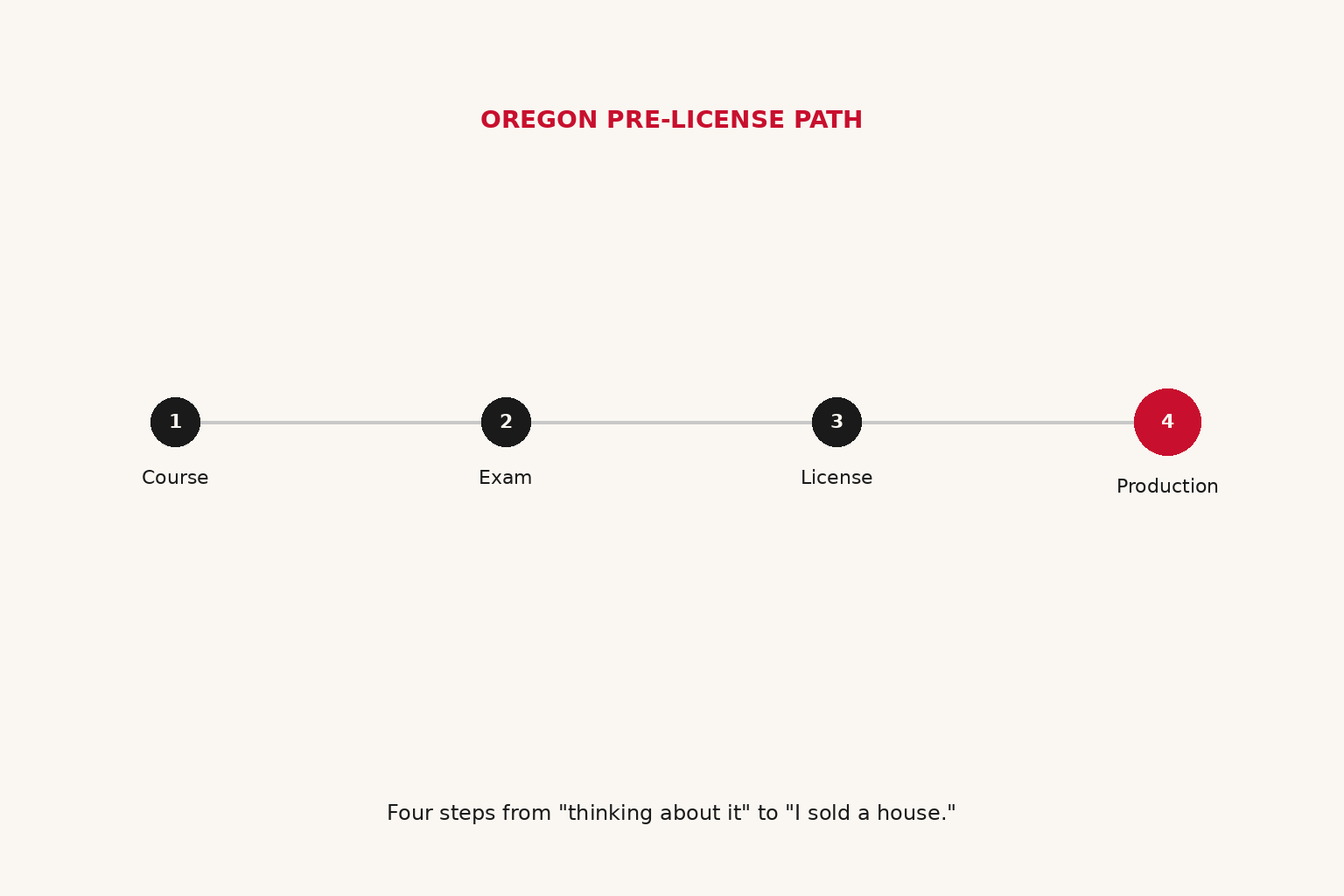
Short answer: To become a licensed real estate broker in Oregon in 2026, you need to complete 150 hours of approved pre-licensing education, pass the Oregon real estate broker exam, clear a background check, and activate your license under a licensed principal broker. The full process typically takes 3–6 months and costs between $1,000 and $2,000 depending on your course provider and exam fees.
Oregon is one of the more straightforward states for real estate licensing. There’s no minimum age beyond 18, no college degree requirement, and no prior real estate experience needed. Here’s the complete step-by-step guide for 2026.
Step 1: Meet the basic eligibility requirements
Before enrolling in any course, confirm you meet Oregon’s baseline requirements:
- At least 18 years old
- Have a high school diploma or equivalent (GED)
- Be able to pass an Oregon background check (criminal history is reviewed on a case-by-case basis — having a record doesn’t automatically disqualify you)
Step 2: Complete 150 hours of Oregon pre-licensing education
Oregon requires 150 hours of pre-licensing education from an Oregon Real Estate Agency (OREA)-approved provider. The curriculum covers Oregon real estate law, contracts, agency relationships, property valuation, finance, and ethics.
You can complete these hours in person, online, or through a hybrid format. Typical timelines:
- Self-paced online: 6–10 weeks if you study consistently
- Instructor-led (weekend format): 8–12 weeks
- Accelerated programs: some providers offer intensive formats that can be completed in 4–5 weeks
Cost for pre-licensing courses typically ranges from $300 to $700 depending on the provider and format. Many providers include exam prep materials in the price.
Step 3: Pass the Oregon Real Estate Broker Exam
Once you’ve completed your 150 hours, you’ll schedule your exam through PSI Services, Oregon’s approved testing provider. The exam has two parts:
- National portion: 80 questions, 2.5 hours, 75% passing score
- Oregon state portion: 50 questions, 1.5 hours, 75% passing score
You can take both portions on the same day or on separate days. Exam fee is approximately $75 per attempt. First-time pass rates in Oregon hover around 60–65% for the national portion — the state portion is typically higher. Invest in exam prep materials from your course provider and take multiple practice tests before scheduling.
Step 4: Submit your Oregon license application
After passing both exam portions, you’ll apply for your license through the Oregon Real Estate Agency’s online portal. You’ll need to:
- Submit proof of exam passage
- Complete a background check (fingerprinting through an OREA-approved vendor, approximately $60)
- Pay the license application fee (approximately $300)
- Provide your principal broker’s license number (you must have a supervising principal broker to activate your license)
Processing typically takes 1–3 weeks. You cannot practice real estate in Oregon until your license is active.
Step 5: Choose a brokerage and activate your license
This is the step most licensing guides rush past — and it’s arguably the most important decision you’ll make as a new agent.
In Oregon, new brokers must work under a licensed principal broker. You can’t practice independently. Your brokerage choice determines your training, your support systems, your commission structure, and the culture you work in every day. This decision shapes your first 2–3 years in the business more than any other factor.
Things to evaluate when choosing a brokerage:
- New-agent training program: does it exist and is it in-person or self-directed?
- Mentorship: will you have a coach or accountability partner, or are you on your own?
- Commission split and cap: understand the full economics before you sign
- Technology: what CRM and transaction management tools are included?
- Culture: are agents collaborative or competitive? Do they refer business to each other?
- Track record: what percentage of new agents at this brokerage close their first deal within 90 days?
At KW Portland Central, most new agents close their first deal within 90 days of licensing. That’s not marketing — it’s the result of a structured new-agent training track, Monday Morning Power Hour, in-person coaching, and a collaborative culture where experienced agents invest in newer ones.
Step 6: Complete post-licensing education
Oregon requires new brokers to complete a 3-hour post-licensing course within the first year of licensure. This is a relatively light requirement compared to other states and shouldn’t be a significant burden.
Ongoing: Oregon brokers must complete 30 hours of continuing education every two years to renew their license. Most active brokerages (including KWPC) offer CE classes regularly — at KW Portland Central, most CE classes are included at no cost to agents.
Oregon licensing at a glance: full cost breakdown
- Pre-licensing course: $300–$700
- Exam fees (PSI): ~$75 per attempt
- Background check / fingerprinting: ~$60
- License application fee: ~$300
- NAR / local association dues (first year): $500–$800
- MLS access fees (first year): $200–$500
- Total estimated first-year licensing cost: $1,400–$2,400
Note: association and MLS fees are ongoing annual costs. Most brokerages do not cover these — budget for them upfront.
Oregon vs. Washington licensing
If you’re in the Portland metro and considering serving Clark County, WA (Vancouver, Camas, Battle Ground), you’ll need a Washington real estate license in addition to your Oregon license. Oregon and Washington do not have reciprocity — you’ll need to complete Washington’s licensing requirements separately. Washington requires 90 hours of pre-licensing education, passing the Washington state exam, and finding a Washington managing broker to supervise you.
KW Portland Central works with agents licensed in both Oregon and Washington. If you’re exploring the dual-license path, that’s a good conversation for your initial call.
Ready to get started?
Getting your license is the first step. Finding the right place to launch your career is the next one. If you’re exploring brokerages in the Portland area — even before you’ve finished your coursework — a confidential conversation now can save you from making the wrong brokerage decision when your license comes through.
See also: What joining KW Portland Central looks like and the FAQ page for common questions about starting your real estate career in Oregon.